
Jev Meets the Gateway: Millisecond AI Decisions with Odock Flow Studio and Plugins
TypeSafe's Jev answers typed questions in about 100 ms for a fraction of LLM cost. Here is how to wire it into Odock Flow Studio and plugins to route models, gate MCP tool calls, and escalate low-confidence work.
What you should take away
- 1Jev is a decision model, not a chat model: typed Choice, Score, and yes/no answers with probabilities, about 70 to 500 ms, $0.042 per million input tokens, no output token cost (TypeSafe's figures).
- 2Most of what agents spend frontier tokens on is decision-shaped. Moving those decisions to a System One model and acting on them in the gateway cuts cost and latency without touching application code.
- 3Odock Flow Studio provides the plumbing: HTTP Request to ask Jev, Switch and If to branch on the answer, Route Model to pick the tier, Abort or an approval call to stop risky actions, and Run Plugin to mask data before it leaves.
- 4Decisions made in the gateway are enforced for every client and leave evidence: flow traces, usage records, and MCP usage records tied to one request id.
- 5Treat Jev as a filter, not a security boundary: keep deterministic controls (grants, allowlists, budgets, SafetySec) first, and fail safe when the decision service is slow or unavailable.
In September 2026, TypeSafe AI released Jev, a model that does not write text at all. You give it state and a typed question; it gives back a choice, a score, or a yes/no probability, in roughly a tenth of a second. That is exactly the shape of most decisions inside an AI workflow: which model, which handler, is this tool call safe, does a human need to look. This article shows how to run those decisions where every request already passes, in the Odock gateway, using Flow Studio graphs and plugins, so the decision is fast, cheap, enforced, and recorded.
Why a model that cannot write is trending
On September 15, 2026, TypeSafe AI came out of stealth with a $40 million seed round led by DCVC and released its first public model, Jev, in early access. Within a month it had its own talks, explainers, and a trending topic about agents making decisions faster.
The reason is simple. Jev does not generate text. TypeSafe calls it a "System One" model: you send unstructured state, text or JSON, plus a map of typed questions, and it returns typed answers with probabilities:
- Choice: pick one of up to 255 options, with a probability per option and a confidence value
- Score: place the state on an ordered scale of 2 to 10 levels
- Noul: a yes/no question that returns the probability of "yes"
All questions in one call run in parallel against the same state. TypeSafe reports 70 to 500 ms end to end and a price of $0.042 per million input tokens, with output tokens free. Early adopters report concrete wins: one writeup estimates scoring a million reviews at about $6 on Jev versus about $1,050 on a frontier model, and Good Start Labs reported 91.5% agreement with Claude's verdicts across 6,003 rubric checks.
The caveats matter as much as the numbers. Most figures are TypeSafe's own or come from early adopters. Jev is hosted only, in early access, behind a waitlist. It cannot fetch live data, it cannot write prose or code, and a schema guarantees a well-formed answer, not a correct one. In TypeSafe's own evaluation it trails the best frontier models on accuracy. It is a fast, cheap, calibrated judge, not a smarter brain.
That is exactly why it belongs in infrastructure.
Most agent spend is decision-shaped
Look at what an agent actually does between the interesting parts. It classifies an intent. It picks a tool. It decides whether a result is good enough. It decides whether to retry, escalate, or stop. Each of those is a question with a small, known set of answers, and most teams answer them by calling a frontier model and parsing its text.
That pattern is expensive in three ways:
- Cost. Gartner warned in August 2026 that while token prices keep falling, inference costs for agentic workflows will rise more than fivefold over two years, because agents use 5 to 30 times more tokens than chatbots for equivalent tasks.
- Latency. A frontier model asked to "just decide" still takes seconds. Routers built on an LLM-as-judge can add 1 to 5 seconds to every request.
- Inconsistency. When the decision lives in each application's prompt, every team implements routing, escalation, and tool approval differently, and none of it shows up in one audit trail.
A System One model fixes the first two. The gateway fixes the third.
Why the decision belongs in the gateway
You could call Jev from application code. Many teams will. But the decisions that matter most for a company are not owned by one application:
- which model tier a request is allowed to use
- whether an agent's tool call is consistent with the task it was given
- when a human must be pulled in
- what gets recorded for audit
Those are platform decisions. In Odock, every model call and every MCP tool call already passes through one lifecycle: authenticate, authorize, inspect, reserve budget, route, record. Flow Studio lets you insert your own logic at four phases of that lifecycle (pre-route, pre-upstream, post-upstream, post-response) as a visual or YAML node graph. Plugins from the Marketplace run at the same phases and can be invoked from a flow.
Put Jev there and you get properties application code cannot give you:
- Enforced for every client. The support bot, the internal copilot, and the agent worker all get the same routing and the same tool gate, without a code change.
- Composed with deterministic controls. Access grants, MCP tool allowlists and blocklists, budgets, quotas, and SafetySec still run. Jev adds judgment on top; it does not replace policy.
- Recorded. Every flow run leaves a node-by-node trace (node, outcome, duration) attached to request evidence, next to the usage record for the call.
- Reversible. Flows live in a library and only run when activated, on one API key for a pilot or org-wide. Turning one off takes effect on the next request.
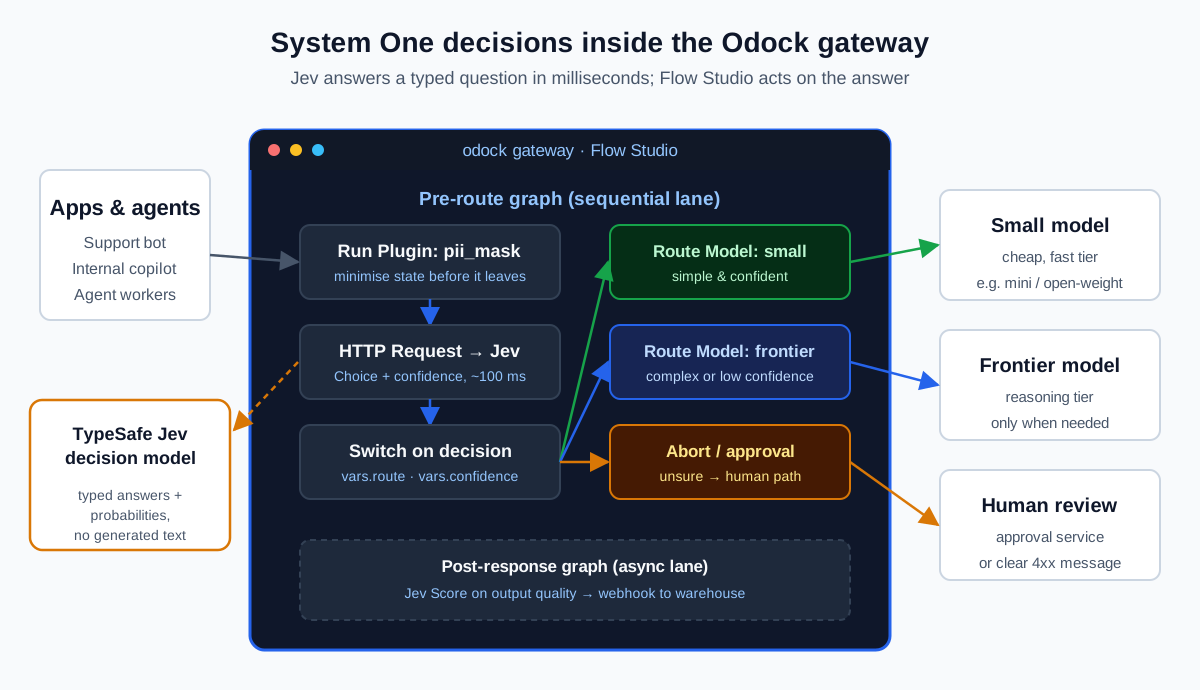
Pattern 1: confidence-aware model routing
The fastest win is routing. Instead of sending every request to the frontier model a developer hardcoded, ask Jev one Choice question at pre-route and let Flow Studio rewrite the target model.
The graph:
1. Run Plugin pii_mask so the state you send out is minimised. 2. HTTP Request to your decision relay, with the user's messages as state and one Choice question: simple, complex, needs_human, other. 3. If confidence is at least 0.8, go to a Switch on the choice. Otherwise keep the frontier model. 4. Switch: simple goes to Route Model with the small tier, needs_human goes to an approval path, everything else falls through unchanged. 5. The HTTP Request's error output goes straight to End: if the decision service is slow or down, the request keeps the model it asked for.
In YAML, the shape looks like this. The relay URL and the response field paths are illustrative; match them to the relay you deploy and TypeSafe's current API reference.
version: 1
name: Jev confidence-aware routing
on_error: continue
phases:
  pre_route:
    nodes:
      - {id: start, type: start}
      - {id: mask, type: plugin_call, config: {slug: pii_mask}}
      - id: jev
        type: http_request
        config:
          method: POST
          url: https://decisions.internal.example.com/v1/route
          body:
            state: "{{request.body.messages}}"
            question: {type: choice, options: [simple, complex, needs_human, other]}
          timeout_ms: 800
      - id: confident
        type: if
        config:
          conditions:
            - {left: "{{nodes.jev.body.confidence}}", op: gte, right: 0.8}
      - id: decide
        type: switch
        config:
          value: "{{nodes.jev.body.choice}}"
          cases:
            - {equals: simple}
            - {equals: needs_human}
      - {id: small, type: model_route, config: {model: gpt-4.1-mini}}
      - id: escalate
        type: abort
        config:
          status: 409
          code: flow.needs_human
          message: "This request needs a human reviewer. It has been queued."
      - {id: end, type: end}
    edges:
      - {from: start, to: mask}
      - {from: mask, to: jev}
      - {from: jev, to: confident}
      - {from: jev, to: end, handle: error}
      - {from: confident, to: decide, handle: "true"}
      - {from: confident, to: end, handle: "false"}
      - {from: decide, to: small, handle: simple}
      - {from: decide, to: escalate, handle: needs_human}
      - {from: decide, to: end, handle: default}
      - {from: small, to: end}
A few details make this production-grade rather than a demo:
- Routing still respects grants. Route Model rewrites the target, but Odock's access grants still decide whether the key may call that model. A flow cannot route a key onto a model it was never granted.
- Budgets see the real model. Budget reservation happens after pre-route, so the estimate is made against the model that will actually be called.
- The default is safe. Low confidence and errors keep the original model. You only save money when the decision is confident.
This is the same pattern Gartner recommends as "inference tiering", stopping agents from defaulting to frontier models for simple tasks, implemented once for the whole organisation.
Pattern 2: gating MCP tool calls
The most important use of a fast judge is not saving money; it is stopping the wrong action. The classic example from the Jev community: npm run db:reset is the correct command when the task is "reset my local database" and a disaster when the task is "add a column".
Static rules cannot tell those apart. A tool allowlist either allows db.reset or it does not. A judgment can.
Odock already gives you the deterministic layers for MCP traffic: an MCP access grant per key, team or key scope, allowed and blocked tools, semantic filters on tool payloads, upstream auth injection so agents never see credentials, and budgets and quotas. Keep all of that. Then add a pre-upstream flow for the small set of high-impact tools:
1. If {{request.metadata.mcp_method}} is tools/call and {{request.metadata.mcp_tool}} is in your high-impact list. 2. HTTP Request to the decision relay with two pieces of state: the task the agent was given (sent by the agent in a header such as x-agent-task) and the pending action, tool name plus {{request.body.params.arguments}}. One yes/no question: "Is this action consistent with the task?" 3. Probability at least 0.9: continue. Between 0.5 and 0.9: call your approval service, as in Odock's built-in MCP external approval gate template. Below 0.5: Abort with a 403 and a clear message the agent can act on. 4. The HTTP Request's error output goes to an Abort with 503. For destructive tools, fail closed.
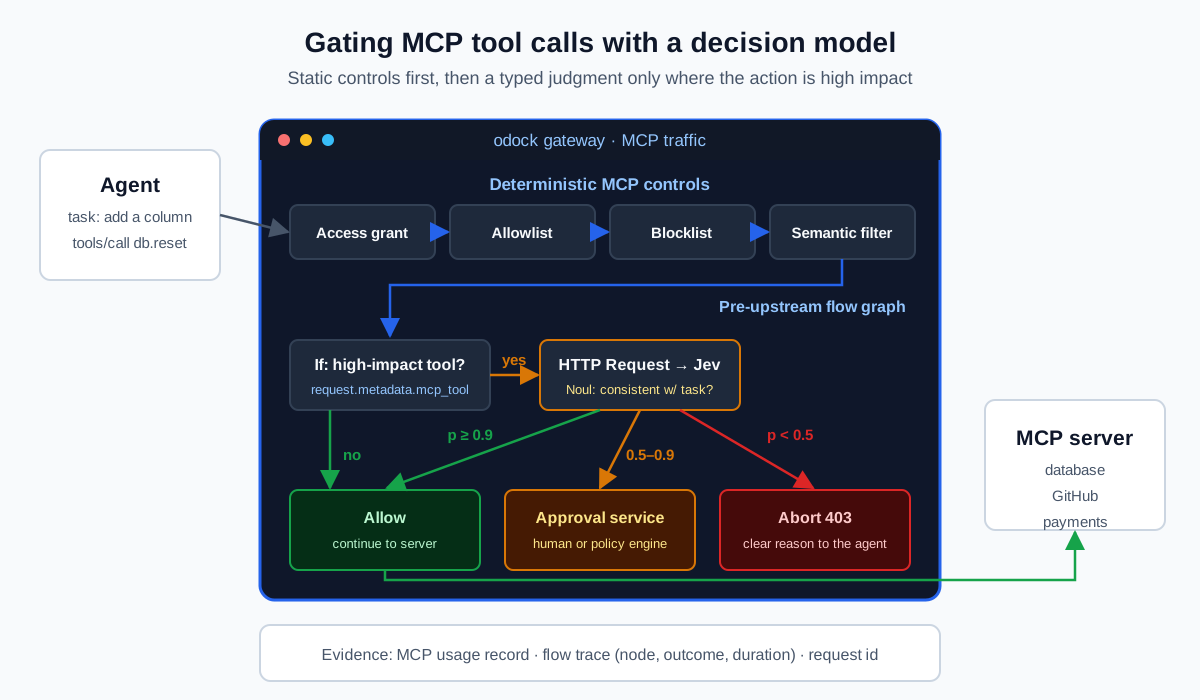
Two design rules from early Jev users apply directly:
- The gate sees the task and the pending action, never the tool's output. Tool output is where indirect prompt injection lives. Keep it out of the judge's state.
- Treat it as a filter, not a boundary. Jev does not treat its input as hostile. That is why it sits behind grants, allowlists, blocklists, and semantic filters, not in place of them.
Every decision lands in Odock's MCP usage records and flow traces with the same request id, so a security reviewer can see which agent key asked for which tool, what Jev answered, and what the gateway did.
Pattern 3: confidence-gated escalation
Calibrated probabilities change how you design human-in-the-loop. Instead of reviewing everything or nothing, use three bands:
- High confidence: act automatically.
- Medium confidence: retry with more context or a stronger model, with a finite limit.
- Low confidence: escalate to a person.
In Flow Studio that is one Switch or two If nodes after the HTTP Request. Combine it with Odock's built-in Agent identity and loop ceiling template, which requires x-odock-agent-id and x-odock-agent-iteration headers and stops runaway loops after a set number of turns, so a medium-confidence retry can never spin forever.
The important part is measurement. Before trusting thresholds, run the flow in shadow mode: have it record the decision without acting on it, label 100 to 200 real cases, and check whether 0.9 confidence really means 90% correct for your traffic. Then turn on the automatic paths.
Pattern 4: free scoring after the response
The post-response phase runs asynchronously by default. It cannot change what the caller received and it adds no latency. That makes it the right place for quality scoring:
- read the model output with a Get Response Value node
- ask Jev for a Score (for example, answer completeness from 1 to 5) and a Noul (did the answer give medical or legal advice?)
- send the result with a Send Webhook node to your warehouse or eval pipeline
You get continuous evaluation on real traffic for a cost measured in cents, and you can compare quality per model tier to check whether Pattern 1 is routing correctly.
Plugins, flows, and Jev: who does what
The cleanest architecture keeps each component on the job it is good at:
| Component | Job | Example |
|---|---|---|
| Access grants, budgets, quotas | Deterministic policy | Key X may call these models and MCP servers, within this monthly spend |
| SafetySec | Prompt and response safety | Prompt injection, jailbreak patterns, redaction, leakage |
| Marketplace plugins | One reusable, audited job | pii_mask, SIEM export, Slack notification |
| Flow Studio | Conditional logic and orchestration | When to ask Jev, what to do with the answer, how to fail |
| Jev | Fast typed judgment | Which tier, is this action consistent, how good was this answer |
When a decision becomes load-bearing and your security team wants to review it as source code rather than a canvas, move it from a flow into a custom plugin. That is also the right home for the TypeSafe credential: plugin secrets are stored as admin variables, encrypted in the browser before they reach Odock and decrypted only when the plugin executes.
Rollout checklist
- Keep the key out of the flow document. Flow documents are configuration that organisation roles can view. Put the TypeSafe key in a small relay you control, or in a custom plugin's admin variables, not in an HTTP Request header.
- Make the relay reachable. Flow HTTP Requests refuse private and loopback addresses by default, so expose the relay on an endpoint your deployment allows.
- Minimise state. Run
pii_maskfirst and send only the fields each question needs. - Bound latency. Set
timeout_mswell below the 30-second ceiling; 500 to 800 ms is a good start for request-path decisions. - Choose the failure mode per decision. Routing fails open to the requested model. Destructive tool calls fail closed.
- Pilot on one key. Activate the flow from a single API key's Automation tab, run matching, non-matching, failure, and abort scenarios, read the flow traces, then switch it on org-wide.
- Watch the numbers. Compare cost per request and quality scores per tier in usage records before and after.
The bigger picture
Jev is an early example of a broader shift: AI systems are splitting into fast judges and slow thinkers. The slow thinkers write, plan, and reason. The fast judges route, gate, score, and escalate. Companies that let every application wire those judges differently will rebuild the same governance problem they had with provider keys.
The gateway is where the two systems meet. It sees every request, it enforces policy, and it keeps the record. With Odock Flow Studio and plugins, a decision model becomes a shared, governed capability for every team and every agent, not one more integration hidden in application code.
Sources
- You.com, What is Jev? (TypeSafe AI overview, API shape, pricing, limitations)
- My AI Community, Every AI Agent Starts With a Decision. Jev Just Made It Cheap, October 7, 2026
- Sarthak AI, Ways to Use Jev to Make AI Agents More Reliable
- Callstack, Can Jev Make AI Agent Decisions Faster?
- Computerworld, AI inference is getting cheaper, but your agents are getting more expensive, August 17, 2026
- Odock Flow Studio documentation
- Odock Flow Studio building blocks
- Odock plugin architecture
- Odock MCP security
What you should take away
- 1
Jev is a decision model, not a chat model: typed Choice, Score, and yes/no answers with probabilities, about 70 to 500 ms, $0.042 per million input tokens, no output token cost (TypeSafe's figures).
- 2
Most of what agents spend frontier tokens on is decision-shaped. Moving those decisions to a System One model and acting on them in the gateway cuts cost and latency without touching application code.
- 3
Odock Flow Studio provides the plumbing: HTTP Request to ask Jev, Switch and If to branch on the answer, Route Model to pick the tier, Abort or an approval call to stop risky actions, and Run Plugin to mask data before it leaves.
- 4
Decisions made in the gateway are enforced for every client and leave evidence: flow traces, usage records, and MCP usage records tied to one request id.
- 5
Treat Jev as a filter, not a security boundary: keep deterministic controls (grants, allowlists, budgets, SafetySec) first, and fail safe when the decision service is slow or unavailable.
Frequently asked questions
What is Jev?
Jev is a 'System One' decision model released in early access by TypeSafe AI on September 15, 2026. It takes unstructured state and returns typed answers, a Choice among options, a Score on a scale, or a yes/no probability, each with calibrated confidence. It does not generate free text.
Does Odock have a native Jev integration?
No. Jev uses its own API rather than an OpenAI-compatible endpoint, so you call it from a Flow Studio HTTP Request node, ideally through a small relay that holds the TypeSafe key, or package the call as a custom Odock plugin whose credential is stored as an encrypted admin variable.
Where in the request lifecycle should the Jev decision run?
Model routing decisions belong in the pre-route phase, before Odock resolves routing, budgets, and safety. MCP tool-call gating belongs in pre-upstream, immediately before the call reaches the MCP server. Output scoring belongs in post-response, where it runs asynchronously and adds no latency for the caller.
What happens if Jev is slow or unavailable?
The HTTP Request node exposes an error output. For routing, wire the error branch to the end node so the request keeps its original model. For destructive tool calls, wire it to an Abort node so the action fails closed. Keep the node timeout short, for example 800 ms.
Is it safe to send prompts to an external decision model?
Only after minimisation. Run a masking plugin such as pii_mask through a Run Plugin node before the HTTP Request, send only the fields the question needs, and review TypeSafe's data handling like any other vendor that receives request content.
Put fast decisions where every request already passes
Odock Flow Studio lets you route models, gate MCP tool calls, and call external decision services from the gateway, with traces and usage records for every run.
Related articles
How to Build a Plugin Layer for LLM Workflows Without Turning Apps into Glue Code
As AI workflows grow, every app starts adding the same glue: prompt filters, output validators, routing rules, and callbacks. A gateway plugin layer keeps that logic reusable.
Read articleThe 6 MCP Security Risks Every Enterprise Faces in 2026
The Model Context Protocol made it trivial to give AI agents tools. It also made it trivial to give attackers a way in. These are the six MCP security risks enterprise teams keep hitting in 2026, and the gateway controls that shut each one down.
Read articleHow to Control LLM Costs with Virtual API Keys, Budgets, and Quotas
The fastest way to lose control of AI economics is to let every service hit providers directly with shared credentials. This article shows the operational model teams need instead.
Read articleThe Great Model Churn of 2026: Why Model-Agnostic Routing Stopped Being Optional
329+ tracked model releases and counting, a new one roughly every three days, open-weight models now competitive with frontier ones. The model layer is churning faster than any application should try to track by hand. Here is what that means architecturally.
Read article